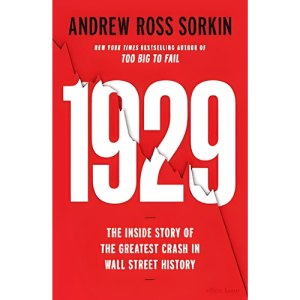
1929: The Inside Story of The Greatest Crash in Wall Street History
This #1 international bestseller has been widely celebrated as one of the most important books of the year, earning recognition as a Best Book of 2025 from leading publications including The Financial Times, The Economist, New Statesman, Bloomberg, and The New York Times. It was also named among Barack Obama’s favorite books of the year and praised by critics as one of the finest narrative histories ever written.
From the acclaimed author of Too Big to Fail hailed as the definitive account of the 2008 banking collapse Andrew Ross Sorkin returns with a gripping and deeply researched chronicle of the most infamous stock market crash in history. This time, he turns his focus to 1929, a year that forever altered global finance and set the stage for economic consequences that continue to shape the modern world.
In the late 1920s, Wall Street appeared unstoppable. Markets surged, fortunes multiplied overnight, and optimism ruled the financial imagination. Then, seemingly without warning, the bull market collapsed. The crash of 1929 erased vast amounts of wealth, shattered public confidence, and triggered a global economic depression that would define an entire generation. While history often remembers the crash through images of panicked traders and plunging ticker tapes, this book reveals that an equally dramatic story was unfolding beneath the surface.
Drawing on extraordinary access to archival material and newly uncovered documents, Sorkin reconstructs the events leading up to the collapse with cinematic detail. He introduces readers to a world populated by towering financiers, ambitious visionaries, reckless speculators, and outright fraudsters individuals driven by belief in endless growth and blinded by the conviction that the rules of the past no longer applied.
At the heart of the narrative is a fierce struggle for power between Wall Street and Washington. As markets soared and then unraveled, policymakers and financial leaders clashed over responsibility, regulation, and control. Decisions made in moments of euphoria and hesitation in moments of warning proved disastrous. Alarms were raised by skeptics who recognized the danger ahead, yet their concerns were dismissed in favor of profit and momentum.
What makes this account especially compelling is how closely the era mirrors our own. The extreme highs and devastating lows of the 1920s echo today’s world of soaring asset prices, political polarization, and debates over financial influence. The book shows that while technology and institutions may change, human behavior greed, fear, ambition, and denial remains remarkably consistent.
This is not merely a book about markets and money. It is a story about power, psychology, and the seductive illusion that “this time is different.” It examines how collective optimism can override reason, how warning signs are ignored when they threaten prosperity, and how financial systems repeatedly fall victim to the same patterns of speculation and excess.
Sorkin’s storytelling blends rigorous journalism with narrative drive, transforming complex economic history into an absorbing human drama. His ability to weave together personal ambition, political maneuvering, and systemic failure brings the era vividly to life. Readers are not only shown what happened, but why it happened and how easily similar conditions can arise again.
After redefining how modern financial crises are told with Too Big to Fail, Sorkin delivers another landmark work with 1929. More than a historical account, the book serves as a vital framework for understanding financial cycles, the roots of economic upheaval, and the warning signals societies repeatedly overlook.
Timely, immersive, and unsettling, 1929 offers essential lessons for investors, policymakers, and readers seeking to understand the forces that continue to shape our economic world and the risks we face when history is forgotten.