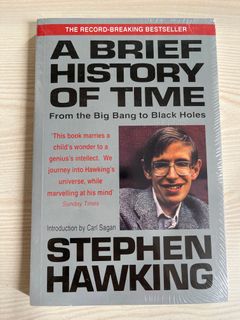
A Brief History of Time Book Review : Unlocking the Secrets of the Universe
Stephen Hawking’s A Brief History of Time is a groundbreaking book that brings the wonders of the universe to the fingertips of readers. First published in 1988, this book explores complex scientific concepts like black holes, time travel, and the Big Bang in a way that is accessible to both scientists and curious readers. It is an inspiring read that not only expands our understanding of the cosmos but also ignites curiosity about the nature of existence itself.
Hawking’s brilliance lies in his ability to break down difficult theories into digestible ideas, making readers feel like they are part of an exciting scientific journey. His exploration of time, space, and the universe challenges us to think beyond what we know and embrace the mysteries that remain unsolved.
Overview: A Journey Through Space and Time
A Brief History of Time is an attempt to answer some of the biggest questions about our universe:
-
How did the universe begin?
-
What are black holes?
-
Is time travel possible?
-
What is the nature of space and time?
-
Will the universe have an end?
Hawking takes readers on an intellectual adventure through the fundamental principles of physics, from Newton’s laws to Einstein’s theory of relativity and quantum mechanics. The book is not just about scientific facts but also about humanity’s relentless quest to understand the universe.
Key Concepts from A Brief History of Time
-
The Origin of the Universe and the Big Bang Theory
Hawking explains how the universe began with the Big Bang—a massive explosion that set everything into motion. He explores the evidence behind this theory and how scientists believe the universe continues to expand. -
Time and Space are Interconnected
The book dives into Einstein’s Theory of Relativity, showing how space and time are not separate but part of a single fabric known as spacetime. This concept challenges our everyday understanding of time. -
Black Holes: The Mysterious Giants of the Universe
One of the most exciting sections of the book covers black holes—regions in space with gravitational forces so strong that nothing, not even light, can escape them. Hawking introduces his famous discovery of “Hawking Radiation,” which suggests that black holes slowly evaporate over time. -
The Arrow of Time and the Possibility of Time Travel
Hawking discusses why time seems to flow in only one direction and whether time travel could ever be possible. While theories suggest that time loops or wormholes might exist, practical time travel remains beyond our reach. -
The Search for a Unified Theory
One of Hawking’s lifelong pursuits was the quest for a “Theory of Everything”—a single equation that could explain all forces of nature, from gravity to quantum mechanics. While such a theory remains elusive, A Brief History of Time introduces readers to the exciting challenges physicists face.
Why This Book is a Must-Read
-
It makes science accessible: Hawking simplifies complex theories, making them easy for non-scientists to understand.
-
It sparks curiosity: The book encourages readers to think about deep questions regarding our existence and the nature of reality.
-
It bridges the gap between science and philosophy: Beyond physics, the book also touches on philosophical questions about the universe and our place in it.
-
It’s inspiring: Hawking’s personal story of overcoming adversity (living with ALS) adds a powerful layer of inspiration to his scientific insights.
Writing Style: A Brilliant Blend of Science and Simplicity
Hawking writes in a way that is both intelligent and engaging. He avoids technical jargon whenever possible and uses relatable analogies to explain abstract concepts. The book is not a light read, but it rewards those who are willing to explore its ideas with a profound understanding of the universe.
Final Thoughts: A Mind-Expanding Experience
A Brief History of Time is a masterpiece that makes the mysteries of the universe accessible to everyone. Whether you’re a science enthusiast or a casual reader, this book will challenge your understanding of time, space, and existence itself. It is a thought-provoking and inspiring read that reminds us of the endless possibilities of human knowledge.