
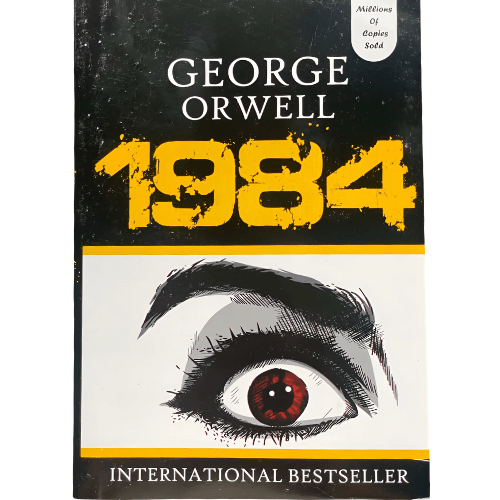
1984 by George Orwell is a landmark in dystopian literature, a novel that not only reflects the fears of its time but continues to speak to the anxieties of generations that followed. First published in June 1949, the book was George Orwell’s final and most powerful work, written in the aftermath of World War II and during the rise of totalitarian regimes across Europe. With chilling foresight, Orwell paints a bleak and oppressive future in which the very idea of freedom is obliterated by the all-encompassing control of the state.
The novel is set in Oceania, one of three superstates—alongside Eurasia and Eastasia—that have carved up the globe following a catastrophic global conflict. Oceania is governed by a political entity known as the Party, led by the omnipresent and godlike figure Big Brother. Through surveillance, propaganda, manipulation of language, and historical revisionism, the Party exerts total control over its citizens—not just their actions, but their thoughts and emotions.
The story follows Winston Smith, a low-ranking member of the Party who works at the Ministry of Truth, where his job is to alter historical records so they align with the constantly shifting narratives approved by the Party. Despite outwardly conforming to expectations, Winston harbors deep resentment and suspicion toward the regime. He believes in truth, independent thought, and emotional freedom—qualities that are strictly forbidden in the authoritarian state.
Winston’s quiet rebellion becomes bolder when he begins a secret love affair with Julia, a passionate and defiant young woman who also resists the Party’s repression. Together, they rent a hidden room where they can escape the ever-watching eyes of the Telescreens and experience fleeting moments of genuine human connection. Their relationship is not merely romantic; it is revolutionary, a direct threat to the Party’s doctrine that aims to suppress all forms of individual pleasure and emotional intimacy.
Their small act of defiance leads them into the path of a supposed underground resistance called the Brotherhood, led by the elusive figure Emmanuel Goldstein, the Party’s designated enemy. But as the novel unfolds, Orwell shatters any hope of escape or resistance. Winston and Julia are betrayed, arrested by the Thought Police, and subjected to brutal psychological torture at the Ministry of Love. In this horrifying place, Winston is confronted by O’Brien, a high-ranking Party member who pretended to be an ally, but is in fact an agent of the regime.
Through relentless torture and reeducation, Winston is forced to abandon his beliefs, betray Julia, and ultimately accept the Party’s absolute control. The final moments of the novel are among the most haunting in modern literature: Winston, once a man who sought freedom and truth, has been entirely broken. He now loves Big Brother.
While the plot of 1984 is compelling and emotionally powerful, its true brilliance lies in Orwell’s incisive political commentary. The novel is a critique of totalitarianism in all its forms, drawing on Orwell’s deep concern about the rise of authoritarian governments, particularly Stalinist Russia and Nazi Germany. Terms such as “Big Brother,” “Thoughtcrime,” “Newspeak,” and “Doublethink” have entered the global lexicon as shorthand for oppressive government control, manipulation of truth, and loss of personal freedom.
1984 is not simply a novel of its time; it is a prophetic warning of what could come if power is left unchecked. It forces readers to question the role of government, the importance of truth, and the fragility of freedom. Orwell’s stark vision of a world without privacy, individuality, or love continues to resonate in a digital age where surveillance, misinformation, and political polarization threaten the very values the book defends.
Ultimately, 1984 stands as a towering achievement in literature—a gripping narrative and a masterclass in political satire. Orwell’s message is both dire and urgent: if we are not vigilant, the horrors of Oceania could become our own. It is a novel that entertains, unsettles, and enlightens, making it not only a must-read but a must-remember.


Reviews
There are no reviews yet.