

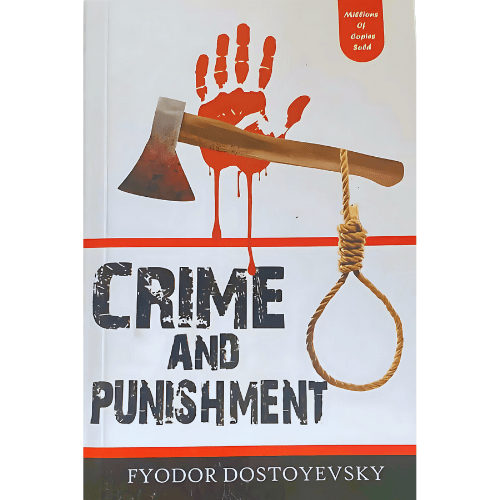
Crime and Punishment
Often hailed as Fyodor Dostoyevsky’s greatest literary achievement, Crime and Punishment is a profound psychological and philosophical exploration of morality, redemption, and the complex nature of human guilt. John Bayley referred to it as Dostoyevsky’s finest masterpiece, and rightly so—it offers readers an unflinching look into the darkness of the human soul and the fragile boundary between virtue and vice.
Set against the oppressive, decaying backdrop of 19th-century St. Petersburg, the novel delves into the troubled mind of Rodion Raskolnikov, a former university student living in extreme poverty. Isolated from society, intellectually arrogant, and emotionally detached, Raskolnikov becomes consumed by a radical theory: he believes that extraordinary individuals possess the right to transgress moral boundaries if it means achieving a higher purpose. Inspired by this notion, he resolves to test the limits of his idea by murdering a pawnbroker a woman he deems worthless and exploitative thinking that her death might even benefit society.
The crime, executed with cold precision, is meant to be a calculated and logical act. Raskolnikov believes he will remain unaffected by it, viewing the murder as a necessary step toward fulfilling his own greatness. However, his plan quickly unravels, and he ends up killing the pawnbroker’s innocent sister as well an unintended consequence that begins to expose the fragility of his philosophical convictions.
Though he escapes immediate suspicion, Raskolnikov’s inner world begins to deteriorate. Far from feeling empowered or justified, he finds himself increasingly tormented by guilt, shame, and paranoia. His mind becomes a battleground of conflicting emotions and thoughts. He swings between justification and remorse, superiority and despair. The intellectual pride that once sustained him now gives way to a crushing moral reckoning.
Raskolnikov’s path gradually intertwines with a range of other characters, each embodying different aspects of human suffering, morality, and hope. Among them is Sonia, a meek and self-sacrificing young woman who turns to prostitution to support her family but clings to her Christian faith and innate compassion. Sonia becomes a symbol of spiritual endurance and moral clarity, gently guiding Raskolnikov toward confronting his guilt and seeking redemption.
Meanwhile, the shrewd and methodical police inspector, Porfiry Petrovich, suspects Raskolnikov but chooses an unconventional approach. Rather than arresting him outright, Porfiry engages him in psychological cat-and-mouse games, slowly tightening the circle around the young man with pointed questions and philosophical probing. Through these encounters, the novel becomes not just a murder mystery but a deep dive into the nature of crime, punishment, and conscience.
As the narrative unfolds, Raskolnikov’s belief that he could transcend ordinary moral constraints crumbles. He is no longer able to ignore the inner voice that accuses and condemns him. Guilt becomes an invisible chain, pulling him down with each passing day. His health deteriorates, his mind unravels, and he begins to understand that no theory, no matter how rational, can shield a human being from the consequences of moral transgression.
Ultimately, it is not the law that punishes Raskolnikov most harshly, but his own conscience. Faced with the abyss of his own spiritual ruin, he turns to Sonia and surrenders not just to the authorities, but to the possibility of moral rebirth. Through suffering and humility, Raskolnikov embarks on the long road to redemption.
In Crime and Punishment, Dostoyevsky paints a haunting portrait of a man caught between intellectual arrogance and moral awakening. The novel remains one of the most powerful studies of guilt, justice, and the redemptive power of love and conscience in the entire history of literature.




Reviews
There are no reviews yet.