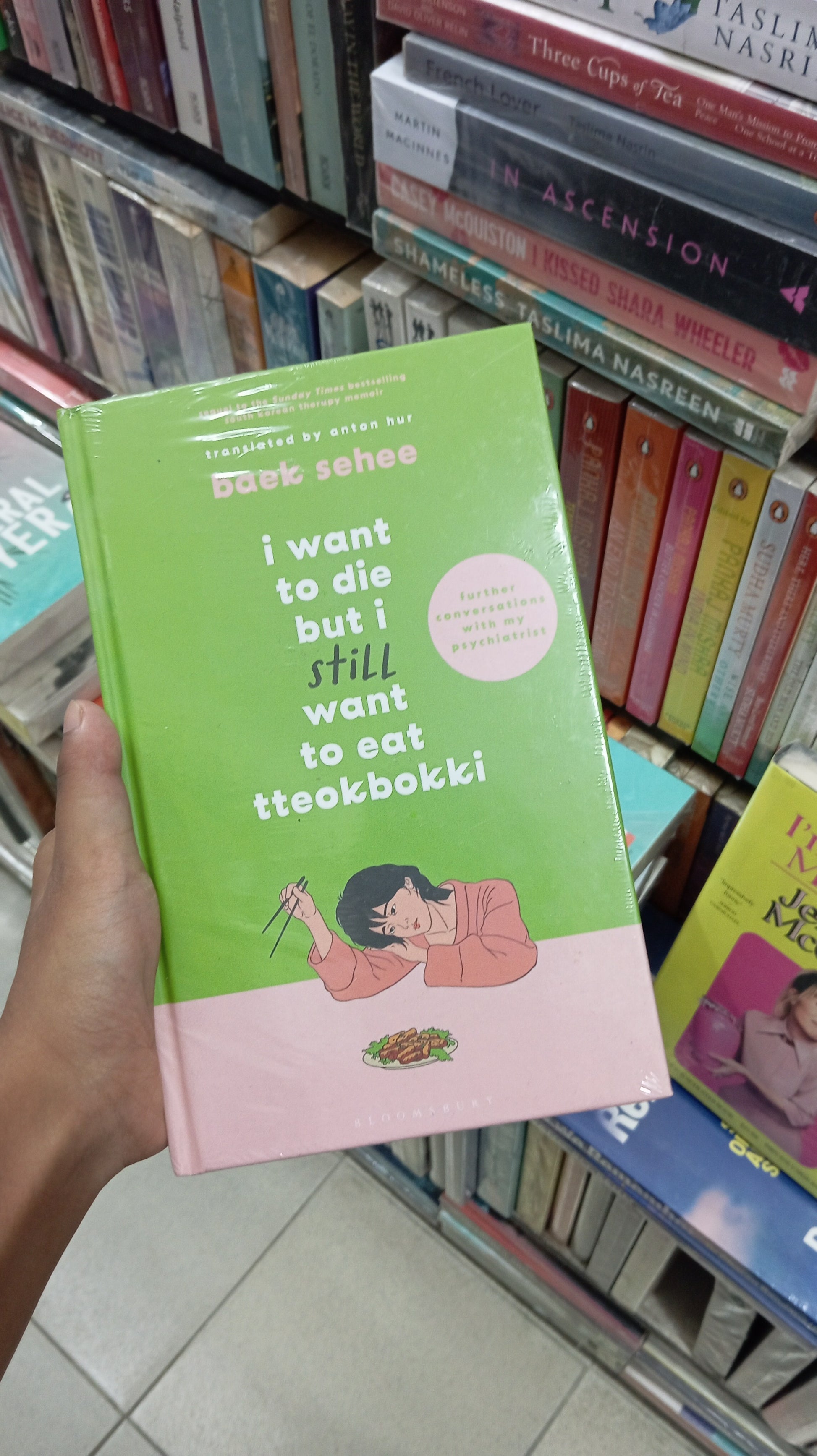
I Want to Die but I Still Want to Eat Tteokbokki Book Review: The Quiet Strength of Survival
In I Want to Die but I Still Want to Eat Tteokbokki, Baek Sehee crafts a deeply moving, introspective, and disarmingly honest account of what it feels like to live with dysthymia—persistent, low-grade depression. In a society that prizes constant productivity, cheerfulness, and outward success, Sehee bravely offers a different narrative: one that embraces contradictions, acknowledges invisible pain, and still finds solace in the simple joys of daily life.
This bestselling Korean memoir is not structured like a typical self-help book or a dramatic confession. Rather, it’s a quiet, fragmented conversation—between the author and her therapist, between her internal monologue and the outside world, and, ultimately, between the shadow of depression and the light of self-awareness. What makes it so powerful is not just the subject matter, but the tone: humble, self-critical, thoughtful, and tender.
Sehee, a successful publishing professional in her late twenties, begins therapy after realizing she is living behind a mask. Outwardly composed and capable, she is internally plagued by negative self-talk, emotional numbness, and feelings of inadequacy. Through therapy transcripts and reflections, we witness her struggle to understand her own mind, to deconstruct why she feels unworthy despite doing “everything right,” and to confront the discomfort of being vulnerable.
Her therapist’s responses are gentle and unhurried. He challenges her assumptions, encourages her to sit with discomfort, and subtly helps her untangle the knots of perfectionism, self-doubt, and societal expectations. These sessions become a window into not only Sehee’s inner world but also the therapeutic process itself—a process that is often slow, repetitive, and sometimes frustrating, yet profoundly human.
What makes I Want to Die but I Still Want to Eat Tteokbokki especially poignant is its attention to everyday contradictions. Sehee doesn’t romanticize her depression, nor does she seek pity. She shows what it’s like to feel deeply sad and still go out for lunch, to feel emotionally detached but still care what others think, to want to disappear but also want to savor something delicious. The title itself is a perfect metaphor for this tug-of-war between despair and desire—the coexistence of death wish and life instinct.
Baek Sehee’s writing style is sparse but lyrical. Her prose, translated gracefully by Anton Hur, flows with quiet introspection and subtle beauty. She captures moments that feel instantly familiar—scrolling through social media to escape, overthinking every interaction, feeling guilty for not being “grateful enough.” Yet, within these small details, she finds connection and meaning. In doing so, she creates space for readers to feel seen in their own quiet battles.
This book is not about a grand recovery. There’s no sudden breakthrough, no dramatic change. Instead, it is about learning to live with yourself. It’s about understanding that healing is not linear, that self-worth takes time to build, and that it’s okay to not be okay—and still want a warm bowl of comfort food.
For readers who have experienced depression, anxiety, or even just the quiet ache of existential doubt, this book offers a mirror. And for those who haven’t, it offers empathy. It reminds us that mental health doesn’t always look like breaking down in tears—it often looks like a smiling face hiding an exhausted heart.
In a culture that demands perfection and instant solutions, Baek Sehee’s memoir is a breath of honest, nourishing air. It’s not a dramatic scream—it’s a gentle whisper saying, “You’re not alone.”
Ultimately, I Want to Die but I Still Want to Eat Tteokbokki is a powerful act of self-expression and emotional courage. It shows us that even in our darkest moments, the smallest desires—like a craving for our favorite food—can be reasons to stay. And sometimes, that’s enough.